
The Handover Pack That Keeps a Scent Consistent at Volume
Approving a sample is a decision made by noses on a particular day; reproducing it at volume is a manufacturing problem, and the two are connected by paperwork rather than by memory. A workable handover pack carries a sealed retained standard, the compounding record, the process parameters, component references and a stated way to judge whether bulk matches. Without those five things, the first bulk batch becomes the new standard by default.
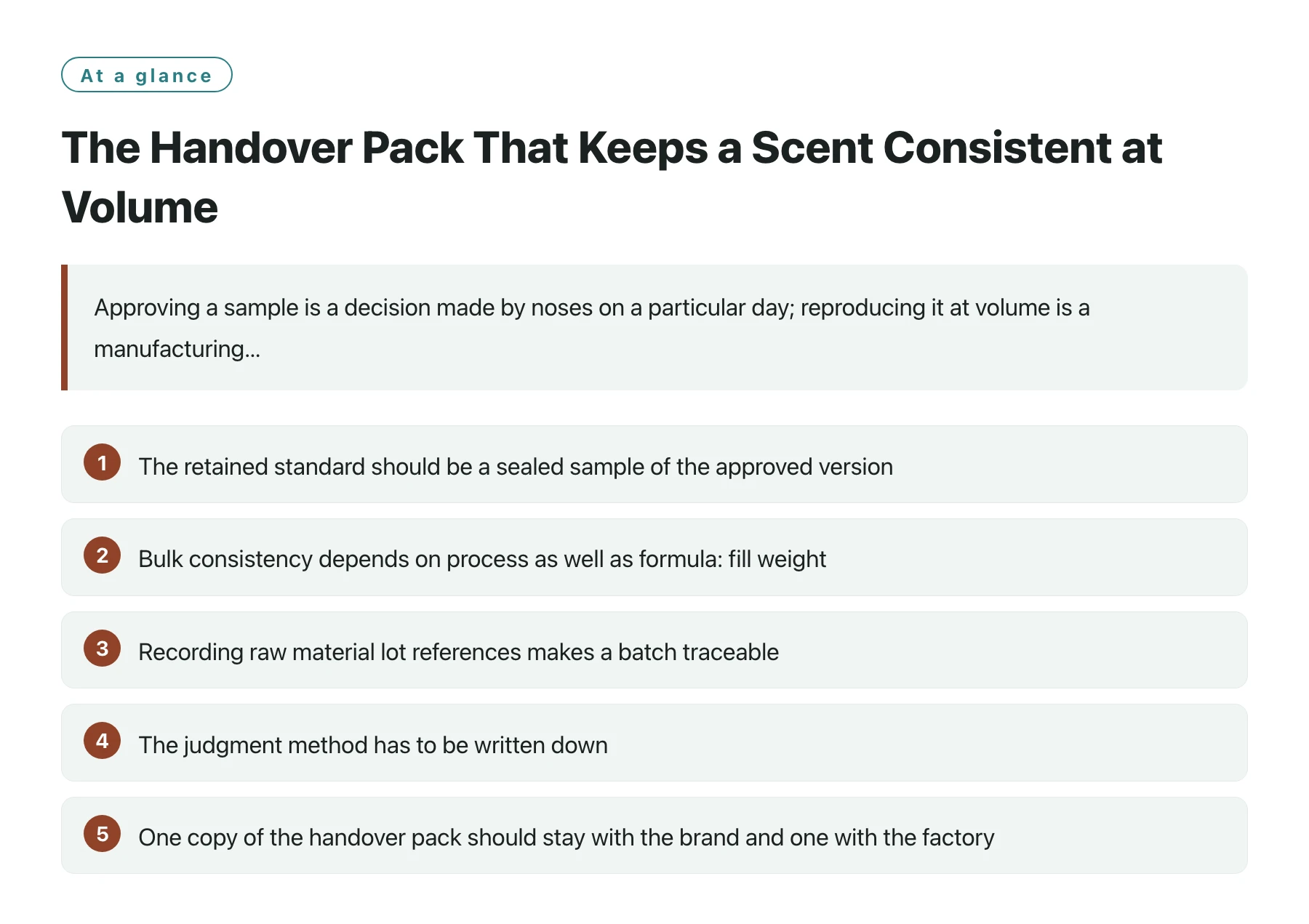
Key takeawaysThe retained standard should be a sealed sample of the approved version, stored under stated conditions, not a bottle that has been handled and opened for months. · Bulk consistency depends on process as well as formula: fill weight, crimping, filtration, batch size and resting time all change what the customer smells. · Recording raw material lot references makes a batch traceable, which is what allows a difference to be investigated rather than argued about. · The judgment method has to be written down, including whether the comparison is made on blotter, on skin, and at what point after filling. · One copy of the handover pack should stay with the brand and one with the factory, because both parties will need it long after the launch. · The first bulk batch deserves a side-by-side check against the retained standard before the rest of the order is filled.
Factories do not reproduce samples by remembering them. They reproduce them from a formula sheet, a process sheet and a reference, and if any of the three is missing or vague, the filling team makes a reasonable decision on the brand's behalf. That decision may be invisible in the first hundred units and obvious in the ten-thousandth.
Quality teams tend to describe this as a documentation problem, and that framing is useful because documentation is the one part of the process that can be fixed before production starts. A sample can only be approved once; the handover pack is what makes that approval repeatable.
This is written from the perspective of the person who has to release the bulk order: what should travel with an approved sample, why each item earns its place, and how to check the first batch without turning it into a debate about taste.
Why a sample cannot be the only reference
A sample is a physical object with a history. It has been shipped, opened, smelled in a meeting, left near a window and possibly re-tested several times. Its contents have been exposed to air, and its label may say only the version name. Using it alone as the production reference is asking a factory to match something that is already drifting.
The practical alternative is a small set: one sealed unit kept in controlled conditions as the official standard, one working unit the brand can open and compare against, and the documents that describe how the contents were made. The sealed unit is the reference; the working unit is for day-to-day comparison; the documents are what the factory actually reads.
Temperature and light matter to that storage decision. Most fragrance formulas are sensitive to both, which is why storage conditions belong in the handover notes rather than in someone's memory. The point of the standard is continuity: a brand working with the same scent development and manufacturing partner across several seasonal ranges needs versions that can be compared, and a stored standard is what makes that possible.
What belongs in the handover pack
| Item | Why it is needed | Who should hold it |
|---|---|---|
| Sealed retained standard of the approved version | It is the physical reference for the first and any later batch comparison | One unit with the factory, one with the brand |
| Compounding record for the approved formula | Bulk compounding is done from this, not from the sample bottle | Factory, with a copy available to the brand on request |
| Dosage and fill specification | The same compound at a different dosage is a different product | Both parties, referenced in the order confirmation |
| Process parameters: filtration, mixing, crimping, fill weight tolerance | These change spray behaviour, leakage and the first impression of strength | Factory, summarised for the brand in the batch record |
| Raw material lot references | They make a difference traceable to a supplier lot rather than to opinion | Factory, with lot references stated in the batch record |
| Component and decoration references | Bottle, pump, cap and print all affect spray and perceived quality | Both parties, including a first-off decorated sample |
| Assessment method and release criteria | It defines how a batch is compared and who decides it may ship | Both parties, agreed at approval |
| Resting or maceration conditions before release | The smell shortly after filling is not the smell the customer receives | Factory, with the release date recorded |
The list is deliberately short. Every extra item is a document someone has to maintain, so keep only what would change a production decision.
The process side that documents alone cannot fix
A factory can hold a perfect formula sheet and still produce a batch that smells different, because process variation moves the product. Fill weight changes concentration per spray. Filtration affects clarity and how the liquid atomises. Crimping depth changes leak rates and the force needed to actuate the pump. Batch size changes mixing behaviour.
This is why the handover should include the parameters that the approved sample was made under, not only the ones the brand cares about. If the sample was compounded at a small scale and the bulk order runs in a larger vessel, the mixing profile differs, and that difference can read as a change in the top notes. Brands that keep custom fragrance R&D and production with the same supplier that fills the order have one fewer place for the record to break, because the people who developed the formula are the people reading it at the line.
Testing laboratories describe this combined picture when they assess a cosmetic product: the result depends on the formula, the packaging and the process together rather than on the formula alone, which is why scope of testing is always agreed in advance [1]. The same logic applies inside a fragrance factory, where the release decision should be tied to the parameters that were recorded.
Agreeing how a batch will be judged
Teams that argue about whether a batch matches usually have not agreed how to compare. Fix the method at approval time: how many people assess, on what substrate, at what point after filling, in what order relative to the reference, and what result triggers a hold.
Keep the language structured. Record each impression against the standard as same, weaker, stronger, or different, and describe the difference in terms of specific stages rather than overall quality. Trade publications that cover fragrance development use this stage-by-stage vocabulary for a reason: it separates a genuine formula difference from a normal rest period or a temperature effect [2].
Add the release criteria. A batch that is slightly stronger in the opening but identical in the dry-down is a different situation from a batch that has lost its freshness entirely, and the two should not be handled by the same rule.
Running the first batch comparison
Ask to compare the first bulk batch against the sealed standard before the remainder of the order is filled. Two reasons: a problem caught at batch one can still be corrected within the seasonal window, and a comparison done at the plant is more reliable than one done after shipping.
Run the comparison at the same time of day, with the same people, on the same substrates. Let both samples reach room temperature first. Assess the opening, the middle and the dry-down separately and record the hours. If the batch was filled recently, note the date and repeat the check after the agreed resting period, because a recent fill can read sharper than the standard.
Keep the outcome written. Either the batch is released against the standard, or it is held with a stated reason and a stated action. A conversation that ends with a general impression leaves the next batch with no precedent.
Compliance documents travel with the product
Formula documentation is not only for internal consistency. Fragrance materials are subject to use restrictions that vary by product category, and the documentation showing that a formula respects them is part of what a brand needs in order to place a product on the market [3]. If the handover pack does not identify the category the formula was assessed for, the brand cannot tell whether a future line extension is covered by the same assessment.
That matters most for seasonal ranges, which often extend a core scent into new formats. A soap, a body mist and an eau de parfum do not share the same restriction profile, so the pack should state the categories the formula was evaluated for, and the brand should ask for a new assessment when a format changes.
A supplier that treats these documents as part of the handover, rather than as a request to be answered later, is telling you something useful about how the next order will run. The same is true of a supplier that keeps a copy of the standard alongside the brand. Suppliers such as Xuelei Perfumes, who work on development and production together, generally hold that documentation as a matter of routine rather than as a favour.
The handover pack is the last cheap moment in a project. Assembling it costs an afternoon, and rebuilding it after a batch is disputed costs a season.
Photograph the sealed standard, its label and its storage location, and keep the image with the batch record. When a comparison is questioned months later, a dated photograph is the fastest way to establish what was actually approved.
Sources
- SGS: Cosmetics, Personal Care & Household Testing —— Testing, inspection and certification services for cosmetics and personal care, including microbiological, stability and safety testing aligned with cosmetics GMP.
- Cosmetics & Toiletries —— A technical magazine for cosmetic formulators, covering ingredients, formulation science and testing methods.
- IFRA Standards Library (International Fragrance Association) —— The IFRA Standards Library lists the restrictions the fragrance industry applies to individual fragrance ingredients, based on safety assessments; it is the reference point for compliant fragrance formulation.
Frequently asked questions
What is a retained sample and how long should it be kept?
A retained sample is a sealed unit of the approved version kept as the production reference. Keep one for at least the shelf life of the product plus a margin, because it is the only way to judge whether a later batch has drifted or the standard has aged.
Why does a bulk order smell different from an approved sample?
The usual causes are resting time after filling, raw material lot variation, a change in dosage or fill weight, and process differences such as filtration or mixing scale. Most are normal and manageable when the tolerance and the rest period are agreed in advance.
Who should own the handover pack?
The factory holds the production documents and the brand keeps its own copy of the standard, the approved formula record and the assessment criteria. Both parties need the pack long after the launch, so a single copy in one location is a risk.
Should the first bulk batch be checked before the whole order is filled?
Yes. Checking the first batch against the sealed standard is the cheapest point at which a problem can still be corrected inside a seasonal window. Later inspection can reject a shipment, but it cannot recover the calendar.
Does the fragrance category affect the documentation?
It does. Use restrictions for fragrance materials are set by product category, so the pack should state which categories the formula was assessed for. Extending a scent into a new format may require a fresh assessment.
Ready to spec your next machined component?
Submit drawings for a written quotation in under 24 hours. AS9100D-documented FAI, PPAP, and CMM reports ship with every order.